The Hidden Intelligence on Your Factory Floor
Every manufacturing facility generates vast quantities of data that never gets analyzed. Sensor logs are archived and forgotten. Maintenance records sit in disconnected spreadsheets. And perhaps the largest untapped data source of all -- video footage from security cameras -- streams continuously through recording systems that exist purely for surveillance, capturing thousands of hours of operational activity that nobody ever reviews.
This is dark data: information that is collected and stored but never analyzed or used to inform decisions. In manufacturing, dark data represents an enormous missed opportunity. The operational insights hidden in that footage -- workflow patterns, bottleneck locations, safety incidents, quality deviations -- are exactly the kind of intelligence that plant managers need but rarely have access to in a systematic way.
What Is Dark Data?
Dark data refers to information assets that organizations collect, process, and store during regular business operations but fail to use for any analytical purpose. Industry estimates suggest that between 60% and 90% of all data generated by enterprises qualifies as dark data. In manufacturing environments, this includes machine logs, environmental sensor readings, handwritten inspection notes, email communications, and -- most significantly by volume -- video surveillance footage.
The problem is not that this data lacks value. It is that extracting value from it has historically been prohibitively expensive. Reviewing video footage manually requires human attention in real time. Correlating visual observations with production data requires specialized expertise. And the sheer volume of continuous video streams makes manual analysis impractical at any meaningful scale.
Why CCTV Represents the Biggest Pool of Dark Data
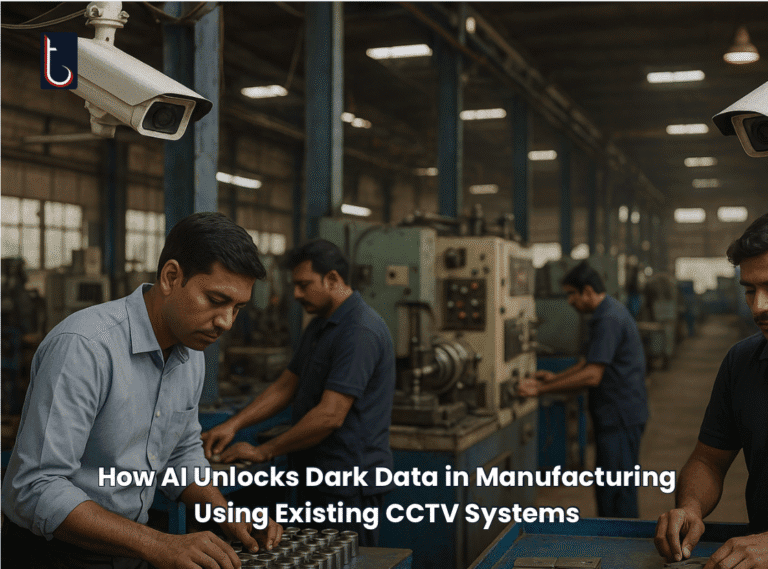
Most manufacturing plants have extensive CCTV infrastructure already in place, installed primarily for security and compliance purposes. A mid-size facility might have 50 to 200 cameras operating around the clock, generating terabytes of footage per month. This footage captures virtually every aspect of plant operations: worker movements, machine states, material flows, loading dock activity, and environmental conditions.
Yet in the vast majority of plants, this footage is only reviewed after an incident occurs -- a safety event, a theft, or a dispute. The continuous stream of operational intelligence flowing through those cameras goes entirely unused. It is recorded, stored for a retention period, and then overwritten. The infrastructure investment has already been made, but the return on that investment is a fraction of what it could be.
What AI Does with Video
Modern computer vision models can process video streams in real time, extracting structured data from unstructured visual information. Object detection models identify people, vehicles, equipment, and materials. Pose estimation tracks body positions and movements. Activity recognition classifies what is happening in a scene. Anomaly detection flags deviations from expected patterns.
When these capabilities are applied to manufacturing CCTV feeds, the result is a continuous stream of structured operational data -- generated from cameras that are already installed and already recording. No new sensors need to be deployed. No new data collection infrastructure needs to be built. The AI layer transforms existing video infrastructure from a passive recording system into an active intelligence platform.
High-Impact Use Cases
Productivity Analytics
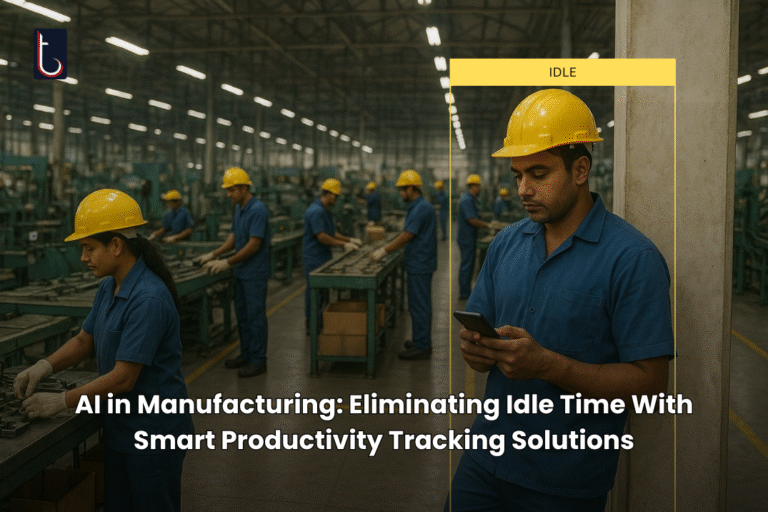
By tracking worker and equipment movements across the plant floor, AI can identify workflow inefficiencies that are invisible in traditional production data. Excessive travel distances between workstations, idle time at bottleneck points, and unbalanced task allocation all show up clearly in movement pattern analysis. These insights allow industrial engineers to optimize layouts and workflows based on actual behavior rather than theoretical process maps.
Quality Control and SOP Compliance
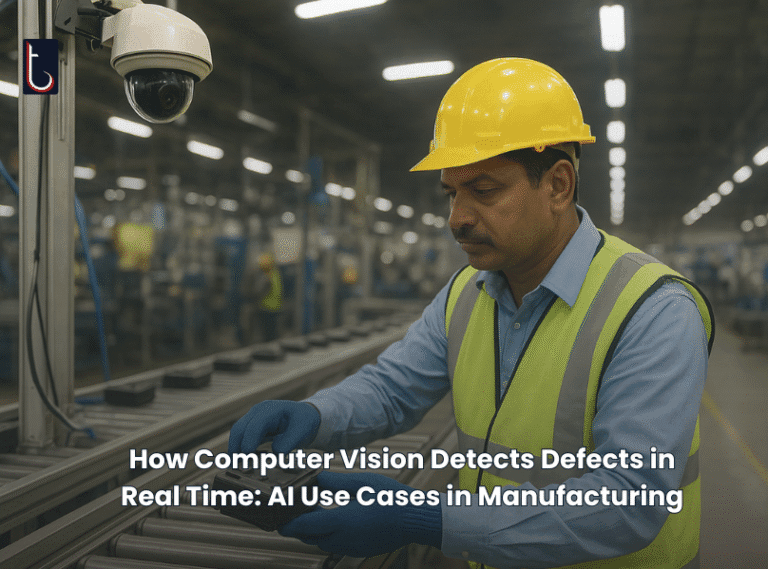
Computer vision can verify that standard operating procedures are being followed at each workstation. Did the operator perform all required inspection steps? Were components assembled in the correct sequence? Was the required PPE worn during the process? Automated SOP monitoring provides continuous quality assurance without relying solely on periodic audits, catching deviations in real time before they propagate through the production line.
Safety and Hazard Detection
AI-powered video analysis can detect safety hazards as they emerge rather than after they cause incidents. Unauthorized entry into restricted zones, missing personal protective equipment, unsafe proximity to moving equipment, and blocked emergency exits can all be identified automatically. Real-time alerts enable immediate intervention, while pattern analysis over time reveals systemic safety risks that might not be apparent from incident reports alone.
Material Movement and Inventory Tracking
Tracking the flow of materials through a facility -- from receiving dock to staging area to production line to finished goods -- is notoriously difficult with traditional methods. Camera-based tracking provides continuous visibility into material locations and movement patterns, helping identify misplaced inventory, quantify handling inefficiencies, and verify that first-in-first-out protocols are being followed.
Predictive Maintenance Signals
While traditional predictive maintenance relies on vibration sensors and temperature probes, visual inspection can provide complementary signals. Unusual vibration visible in equipment, oil leaks, belt wear, and abnormal machine behavior patterns can all be detected through video analysis. These visual indicators often precede sensor-detectable failures, providing an additional early warning layer for maintenance teams.
Realistic Outcomes
It is important to set appropriate expectations. AI-powered video analytics will not instantly transform plant operations. Initial deployments typically focus on a small number of cameras and specific use cases where the business case is clearest. Accuracy improves over time as models are fine-tuned on plant-specific data. The most realistic path involves a phased rollout.
- Month 1-2: Deploy on 5-10 cameras covering high-priority areas. Focus on a single use case such as safety compliance or productivity monitoring.
- Month 3-4: Validate accuracy, refine models, and quantify initial impact. Use findings to build the business case for expansion.
- Month 5-8: Expand to additional cameras and use cases. Integrate video analytics data with existing MES and ERP systems for richer insights.
- Month 9+: Scale across the facility. Establish continuous improvement processes for model accuracy and use case development.
Practical Considerations
Several factors influence the feasibility and effectiveness of CCTV-based AI analytics in manufacturing settings.
Camera quality and positioning: Security cameras are typically positioned for broad coverage at fixed angles, which may not be optimal for all analytics use cases. Some applications may require repositioning cameras or upgrading to higher-resolution models, though many use cases work well with existing HD security cameras.
Network infrastructure: Processing video analytics requires moving video streams from cameras to compute infrastructure. Plants with older CCTV systems using analog cameras or limited network bandwidth may need infrastructure upgrades. Facilities with IP-based camera systems are generally well-positioned for AI integration.
Privacy and labor relations: Using cameras to monitor worker activity raises legitimate privacy concerns and may have implications under labor agreements. Successful implementations are transparent about what is being monitored and why, involve worker representatives in planning, and focus analytics on process improvement rather than individual surveillance.
Compute requirements: Real-time video analytics requires significant compute resources. Edge computing devices deployed near camera clusters can handle initial processing, while cloud or on-premise GPU servers handle more complex analysis. The right architecture depends on latency requirements, data sensitivity, and existing IT infrastructure.
A Checklist for Plant Managers
Before embarking on a CCTV analytics initiative, plant managers should assess their readiness across several dimensions.
- Inventory your existing cameras: How many cameras are deployed? What is their resolution and frame rate? Are they IP-based or analog? What areas do they cover, and what blind spots exist?
- Identify your highest-value use case: Where does the plant lose the most time, money, or safety? Start with the use case that has the clearest ROI and the most executive support.
- Assess network capacity: Can your plant network handle the bandwidth required to stream video from target cameras to processing infrastructure? Identify any bottlenecks.
- Evaluate compute options: Determine whether edge, cloud, or on-premise GPU processing best fits your latency, security, and budget requirements.
- Address privacy and compliance: Review applicable regulations, labor agreements, and company policies. Develop a communication plan for workers and union representatives.
- Define success metrics: Establish clear, measurable outcomes for the pilot phase. Avoid vague objectives. Tie success criteria to specific operational KPIs that the business already tracks.
- Plan for iteration: Expect model accuracy to improve over time. Budget for ongoing annotation, model refinement, and use case expansion beyond the initial deployment.
Closing Thoughts
The most valuable data in many manufacturing facilities is already being captured -- it is just not being used. AI-powered video analytics offers a practical path to unlock this dark data, turning passive surveillance infrastructure into an active source of operational intelligence. The technology is mature enough for production use, the infrastructure is often already in place, and the use cases are well-validated across industries.
The plants that move first will build institutional knowledge, refine their models on proprietary data, and establish operational advantages that compound over time. The question is not whether CCTV analytics will become standard practice in manufacturing -- it is whether your facility will be an early mover or a late follower.