Physical AI · Robot Training Data
Egocentric vs Teleoperation Robot Data: What Differs and Why Both Matter
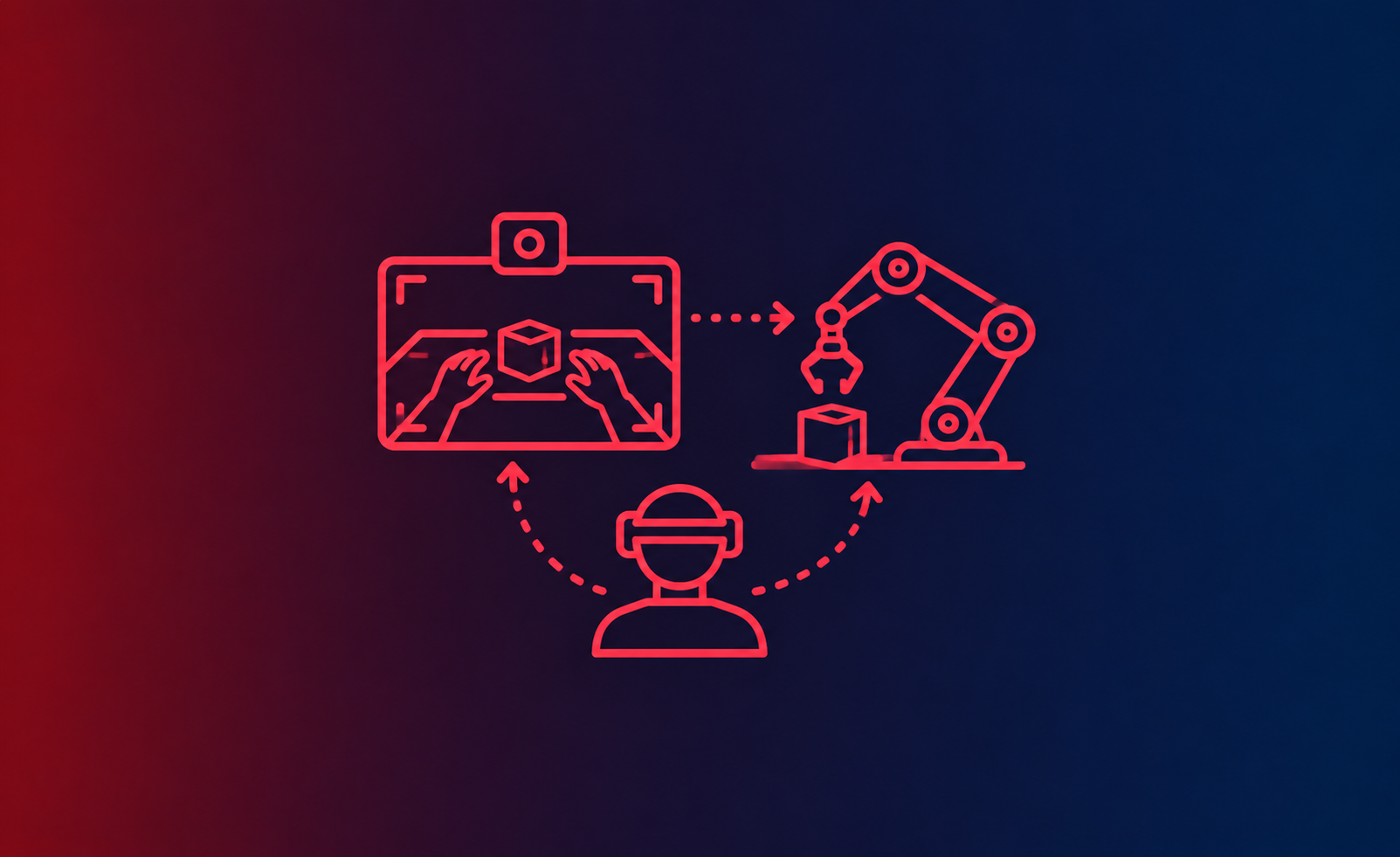
Egocentric human video and teleoperation data are often treated as competing sources for robot training. They solve different problems. Egocentric data offers scale and environmental diversity without requiring robot hardware at collection time. Teleoperation provides robot-specific action fidelity, recording every joint angle and gripper state directly from the robot during execution.
The more important distinction appears at the annotation layer. Egocentric data requires action information to be derived from human motion: retargeting, pose estimation, boundary detection. Teleoperation provides robot actions directly but still requires quality, failure, recovery, and taxonomy labeling. Understanding this difference is what allows a training program to use both modalities effectively.
This piece maps the structural differences between the two modalities and what each requires at the annotation layer, grounded in the research that has clarified their respective roles across 2025 and 2026.
The Structural Difference at a Glance
| Dimension | Egocentric human video | Teleoperation data |
|---|---|---|
| Perspective | First-person, from the human demonstrator's viewpoint | From the robot's own sensors during operation |
| Action labels | Not directly available; must be derived through retargeting, pose estimation, or annotation | Directly recorded: joint angles, gripper states, end-effector positions per timestep |
| Embodiment gap | Significant: human hand kinematics must be mapped to robot end-effector commands | Minimal for the target robot: data is recorded directly from the robot during execution |
| Collection cost | Lower: no robot hardware required at collection time | Higher: skilled operator, physical robot, and configured environment |
| Throughput | Higher: 100 hours produces roughly 45,000 trajectories | Lower: 5 to 50 episodes per hour; 100 hours produces roughly 8,000 trajectories |
| Task and scene diversity | High: any environment a human can enter with a camera | Constrained by available robot hardware and configured environments |
| Action fidelity to target robot | Lower: derived actions carry retargeting error and embodiment approximation | Direct: exact action-state correspondence for the robot being operated |
| Annotation complexity | High: retargeting, hand pose estimation, action boundary detection, episode segmentation, language grounding | Medium: episode segmentation, success and failure labeling, action taxonomy application, language grounding |
What Egocentric Data Contributes
The defining characteristic of egocentric data is scale at low hardware cost, combined with the scene and task diversity that comes from collecting footage wherever a human can go. EgoVLA captures the principled reason this matters: the benefit of human video is not only scale but the richness of scenes and tasks, enabling efficient fine-tuning on in-domain robot demonstrations with less task-specific robot data than would otherwise be required.
EgoScale (2026) trained on over 20,854 hours of action-labeled egocentric video and demonstrated a log-linear scaling law between human data scale and downstream robot performance. Human-as-Humanoid reported a 4.8 to 7.2 times demonstration throughput gain over humanoid teleoperation, and showed zero-shot generalization to robot deployment on tasks never directly demonstrated. Qwen-VLA incorporated egocentric manipulation datasets as 6% of its pretraining mixture specifically to provide broad manipulation priors that complement robot trajectory data.
SEVO found that a diversified collection protocol, varying lighting, backgrounds, and distractors during egocentric collection, was the single most important factor for generalization, while in-distribution-only data produced near-zero transfer to new environments. This is the structural reason egocentric data is well-suited to pretraining: it provides the diversity that teleoperation cannot match at comparable cost.
The annotation challenge: the embodiment gap and retargeting
The structural constraint of egocentric data is that human hands are not robot end-effectors, and the gap between the two grows with robot morphological complexity. Human-as-Humanoid illustrates this precisely: retargeting to a humanoid with high-DoF arms, dexterous hands, and a mobile torso had to be solved in stages for each body part because a monolithic full-body IK problem is poorly conditioned. EgoVLA addresses this by using MANO hand parameters as a shared human-robot action space, training a compact MLP to map 3D fingertip positions in the wrist frame to robot actuation values. Macrodata Labs' 2026 analysis documents the range of approaches, from simple fingertip-to-end-effector IK to full hand model estimation, each making different accuracy and fidelity trade-offs. The key point is that retargeting becomes increasingly difficult as robot morphology diverges from the human hand, and each approach introduces its own error characteristics into the derived action labels.
Beyond retargeting, egocentric annotation requires action boundary detection, episode segmentation from continuous footage, and language instruction generation. Agreement on action boundaries is one of the higher-disagreement annotation tasks in egocentric data, because where one action ends and another begins is often ambiguous in continuous human movement.
At BTA: For egocentric annotation workstreams, we annotate spatial grounding with documented placement and occlusion rules, perform action boundary detection with inter-annotator agreement tracking per sequence, and generate language instructions from scratch for each episode. We also work on top of existing model outputs where labs have already produced automated first passes, concentrating human effort on the annotation layers where automation is least reliable.
What Teleoperation Data Contributes
Teleoperation data has a structural property that egocentric data cannot replicate: the action labels are recorded directly from the robot. When a skilled operator controls a robot through a task, every joint angle, gripper state, force reading, and camera frame is recorded in synchrony with the demonstrated action. As Claru's 2026 definition puts it, this synchronized observation-action pair at every timestep is exactly the training signal that behavioral cloning, Diffusion Policy, and VLA models consume. For the robot being operated, teleoperation largely eliminates the human-to-robot embodiment gap that egocentric data requires annotation to bridge.
This fidelity makes teleoperation data particularly well-suited to contact-rich manipulation tasks where precise force application and exact end-effector positioning determine success. Labellerr's 2026 analysis identifies a related advantage: operators react to errors, contact, and changes in the task in real time, which means teleoperation data naturally contains recovery sequences that purely scripted or simulated sources do not provide.
The constraint of teleoperation is cost and throughput. Real2Render2Real describes it as costly and constrained by manual effort and physical robot access. GigaBrain-0 argues that the inefficiency of physical data collection severely limits the scalability of current VLA systems. The per-hour trajectory yield is substantially lower than egocentric collection at comparable cost.
The annotation challenge: quality distribution and failure coverage
Because action labels are recorded directly from the robot, the annotation work in teleoperation data shifts from derivation to labeling and selection. Skilled operators are motivated to succeed, so the natural distribution of teleoperation data skews toward successful demonstrations. A policy trained primarily on successes does not learn to recover from failure. Deliberate failure annotation, identifying recovery sequences within successful episodes or collecting explicit failure-and-recovery protocols, is the mechanism that adds robustness signal. Without it, each training cycle exposes the policy to the same failure modes it already cannot handle.
Applying a consistent action taxonomy across a large teleoperation dataset is also annotation work that must be done after collection. The same consistency challenges that apply in egocentric programs apply here: without a locked primitive vocabulary and IAA tracking per task type, large teleoperation annotation programs accumulate ontological inconsistency that the model learns alongside the useful signal.
At BTA: For teleoperation annotation workstreams, we apply episode-level quality and success-failure labeling, deliberate recovery behavior annotation, and tiered action taxonomy application with IAA tracked per task type. We treat binary outcome labels as something labs can increasingly generate automatically from task signals, and concentrate human annotation effort on failure point identification and corrective behavior labeling, which have no reliable automated equivalent.
How the Two Modalities Work Together
A common division of labor in production VLA programs is to use egocentric data for pretraining and teleoperation data for fine-tuning and policy anchoring. Egocentric data contributes broad scene and task diversity during pretraining, supporting the manipulation priors that allow a model to generalize across environments. Teleoperation data then grounds those priors in the action space and dynamics of the specific robot.
EgoVLA pretrains on egocentric video and fine-tunes on robot manipulation demonstrations. WholeBodyVLA uses human egocentric footage for locomotion and manipulation priors, then anchors to the target humanoid through teleoperation. Qwen-VLA blends both in its pretraining mixture at proportions calibrated to the target embodiment. The specific balance varies by program. SEVO found that collection diversity, specifically varying lighting, backgrounds, and distractors, was the single most important factor for generalization regardless of modality, while in-distribution-only data produced near-zero transfer to new environments. That finding applies equally to how each modality is collected.
The practical guide for building with both
- Egocentric data: broad task and scene diversity, pretraining and generalization, human action priors, cost-efficient scaling
- Teleoperation data: robot-specific action grounding, contact-rich manipulation, fine-tuning and policy anchoring, recovery sequences
- Shared annotation layer: consistent action taxonomy, language grounding, quality criteria, failure and recovery labels, IAA standards across both sources
The Annotation Layer Is Where the Modalities Diverge Most
At the collection level, the two modalities present different operational challenges. At the annotation level, the differences are more specific and more consequential for training data quality.
Egocentric data annotation is a derivation problem. The raw footage does not contain action labels. Everything the model needs beyond the visual observation must be derived: hand pose, retargeted action representations, action boundaries, episode segments, and language instructions. Each derivation step introduces potential inconsistency that must be managed through calibration and IAA tracking.
Teleoperation data annotation is a labeling and selection problem. The action labels exist. The work is deciding which episodes are usable, how to label quality variation within each episode, how to capture recovery sequences, and how to apply a consistent action taxonomy across the dataset.
One annotation ontology across both modalities
When programs use both modalities, a specific requirement emerges that neither modality creates on its own: the action taxonomy applied to egocentric data and the taxonomy applied to teleoperation data must be consistent. If the same primitive action is labeled differently depending on which modality it came from, combining the datasets introduces conflicting skill representations into the training set. The model learns two versions of the same primitive rather than one transferable unit.
This is one of the most common annotation design failures in programs that transition from single modality to multi-modality data collection, and it is entirely preventable at the schema design stage. A locked primitive vocabulary defined before annotation begins, applied consistently across both sources and all annotators, is what allows egocentric and teleoperation data to function as one training system rather than two separate datasets that happen to be concatenated.
| Annotation task | Egocentric data | Teleoperation data |
|---|---|---|
| Action label source | Derived through retargeting, pose estimation, or annotation | Directly recorded; annotation applies taxonomy and quality labels on top |
| Spatial annotation | Must be annotated or estimated per episode; contact and approach directions are high-value targets | Recorded from robot sensors; annotation may verify or correct drift at critical moments |
| Action boundaries | Higher disagreement; requires calibration and IAA tracking specifically for boundary placement | Lower disagreement; boundaries often visible from action trace discontinuities |
| Episode segmentation | Clips from continuous footage; requires identifying task-relevant segments | Episodes are typically pre-segmented by collection protocol; annotation may refine |
| Language grounding | Must be generated for all episodes; human quality grounding prevents models from learning to ignore language instructions when templates produce repetitive patterns | Must be generated; task description from collection protocol provides a starting point |
| Failure and recovery | Rare in intentional demonstration footage; requires deliberate collection design | Present in operator data as recovery sequences; requires explicit labeling to be captured |
| Quality rating | Per-clip usability assessment; variable due to environmental and operator variation | Per-episode quality and success-failure rating; variable due to operator fatigue and perturbations |
| Action taxonomy | Must be consistent with the taxonomy applied to teleoperation data for cross-modality training | Must be consistent with the taxonomy applied to egocentric data for cross-modality training |
FAQ: Egocentric and Teleoperation Data for Physical AI
What is the main structural difference between egocentric and teleoperation robot training data?
Egocentric data is first-person human video collected without robot hardware. It provides broad task and scene diversity but requires significant annotation work to derive action labels and bridge the embodiment gap. Teleoperation data is recorded from the robot during human controlled operation, providing action labels directly with minimal embodiment gap for the target robot, at higher collection cost and lower throughput per hour.
What is retargeting and why does it matter for egocentric data?
Retargeting converts human hand motion in egocentric video into executable robot action labels. Approaches range from simple fingertip-to-end-effector inverse kinematics to full MANO hand model estimation. The challenge grows with robot morphological complexity: retargeting to a high-DoF dexterous hand requires solving the problem in stages because a monolithic full-body IK is poorly conditioned. Each approach introduces its own error characteristics, which is why the annotation layer, rather than the collection layer, is where egocentric data quality is determined.
What annotation is required for each modality?
Egocentric data requires action boundary detection, spatial annotation and retargeting, episode segmentation, and language instruction generation. Teleoperation data requires episode quality and success-failure rating, recovery behavior annotation, action taxonomy application, and language instruction generation. Both require IAA tracking per task type to maintain consistency at scale.
How should programs combine both modalities?
A common division of labor is egocentric data for pretraining, building broad manipulation priors across diverse scenes, and teleoperation data for fine-tuning and policy anchoring to the specific robot. The critical requirement when combining both is a consistent action taxonomy across both sources. If the same primitive action is labeled differently in egocentric and teleoperation datasets, combining them introduces conflicting skill representations that the model cannot reliably generalize from.
The Practical Takeaway
Egocentric and teleoperation data provide different signals to a physical AI system. Egocentric data expands the diversity and scale of what a model can learn from. Teleoperation grounds those capabilities in the action space and dynamics of a specific robot. When both are used, the annotation layer becomes the bridge between them: a shared primitive vocabulary, consistent quality standards, and aligned language and action representations are what allow the two datasets to function as one training system rather than two separate sources concatenated together. The interesting problem is not choosing between egocentric and teleoperation data. It is designing the annotation system so that both can work together.
Annotating Both Modalities for Physical AI Programs
At Biz-Tech Analytics, we collect and annotate both egocentric and teleoperation data for physical AI and VLA training programs. For egocentric workstreams, that means spatial annotation and retargeting, action boundary detection with IAA calibration, episode segmentation, and language instruction generation. For teleoperation workstreams, that means episode quality and success-failure labeling, recovery behavior annotation, and tiered action taxonomy application. We apply a consistent action taxonomy across both modalities so that cross-modality training programs do not produce conflicting skill representations.
Building an egocentric, teleoperation, or hybrid robotics data program? Explore how we support annotation schemas, action taxonomies, quality frameworks, and cross-modality data pipelines.
.png)