What Is Computer Vision
Computer vision is a branch of artificial intelligence that enables machines to interpret and act on visual information from the physical world. In industrial settings, this means cameras connected to trained neural networks that can detect objects, recognize activities, read text, measure dimensions, and classify conditions -- all in real time and at a scale no human workforce could match.
The core technologies powering industrial computer vision include object detection (identifying and locating specific items within a frame), pose estimation (understanding human body position and movement), semantic segmentation (classifying every pixel in an image), and optical character recognition (reading printed or handwritten text from visual inputs).
How Computer Vision Works in Industrial Settings
Deploying computer vision on a factory floor follows a structured pipeline. The process begins with image capture from strategically placed cameras -- existing CCTV infrastructure can often be repurposed. Raw frames are preprocessed to normalize lighting, orientation, and resolution before being fed into trained detection models.
The detection stage identifies objects of interest: people, products, equipment, safety gear, defects. Classification assigns meaning to what was detected: is this a compliant or non-compliant action, a good or defective part, an active or idle workstation. Finally, the action stage translates classifications into operational outputs: alerts, dashboard updates, automated reports, or trigger signals to other systems.
Processing can happen at the edge (on devices near the cameras for minimal latency) or in the cloud (for more complex models and centralized analytics). Most production deployments use a hybrid approach, with time-critical detections handled at the edge and aggregate analytics processed centrally.
Industrial Applications
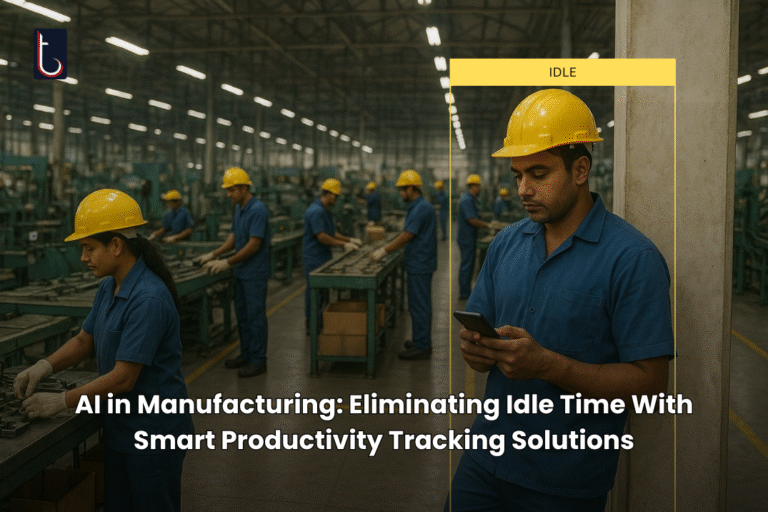
Workforce efficiency monitoring uses activity recognition to measure how time is spent at each workstation. The system distinguishes between productive work, setup activities, material handling, and idle periods, giving supervisors objective data on line performance without manual time studies.
Quality inspection applies visual models to detect surface defects, assembly errors, and dimensional variances. Unlike human inspectors who fatigue and whose attention wanders, AI-powered inspection maintains consistent standards across every unit, every shift.
Safety compliance monitors PPE usage, restricted area access, and hazardous behavior in real time. Violations trigger immediate alerts rather than being discovered after an incident occurs.
Material tracking follows inventory movement through the facility, detecting bottlenecks in material flow and verifying that components arrive at the right workstation at the right time.
Process optimization combines data from all of the above to identify systemic inefficiencies that would be invisible from any single data source. Correlation between productivity patterns, quality outcomes, and process sequences reveals optimization opportunities that manual analysis would never uncover.
Measurable Business Impact
Manufacturers deploying computer vision report consistent improvements across key operational metrics. Idle time reductions of 15-25% are common once supervisors have real-time visibility into workstation activity. Defect escape rates drop significantly when every unit undergoes AI-powered inspection rather than statistical sampling. Safety incident rates decline when PPE compliance is enforced continuously rather than checked periodically.
Perhaps most importantly, the data generated by computer vision systems enables a fundamentally different approach to continuous improvement. Instead of relying on periodic audits and subjective assessments, plant managers can make decisions based on comprehensive, objective, real-time data about every aspect of their operation.
Implementation Considerations
Successful computer vision deployment requires attention to several practical factors. Camera placement and quality directly affect detection accuracy -- models trained on well-lit, properly angled footage perform significantly better than those working with poor inputs. Edge computing hardware needs to match the processing demands of the chosen models and the number of simultaneous camera feeds.
Integration with existing systems -- MES, ERP, SCADA -- determines whether computer vision insights can actually drive operational changes or remain isolated data points. Change management is equally important: frontline workers and supervisors need to understand what the system does, how the data is used, and how it benefits their work rather than simply monitoring them.
The Path Forward
Computer vision capabilities continue to advance rapidly. Models are becoming more accurate with less training data, edge hardware is becoming more powerful and affordable, and deployment tooling is maturing to support faster implementation cycles. For manufacturers, this means that the barrier to entry continues to fall while the capabilities on offer continue to expand. The factories that invest in visual intelligence now will have a significant operational advantage as these technologies become table stakes across the industry.