Why AI in Manufacturing Matters Now
Manufacturing has always been a domain where small efficiency gains compound into significant competitive advantages. A one-percent improvement in throughput across a multi-shift operation can translate into millions in annual output. Yet many facilities still rely on manual observation and periodic audits to assess workforce productivity, methods that capture only a fraction of what actually happens on the floor.
Artificial intelligence, particularly computer vision, offers a fundamentally different approach. By analyzing video feeds from existing cameras, AI systems can provide continuous, objective measurement of workforce activity without requiring workers to change their behavior or interact with additional devices.
The Problem of Hidden Idle Time
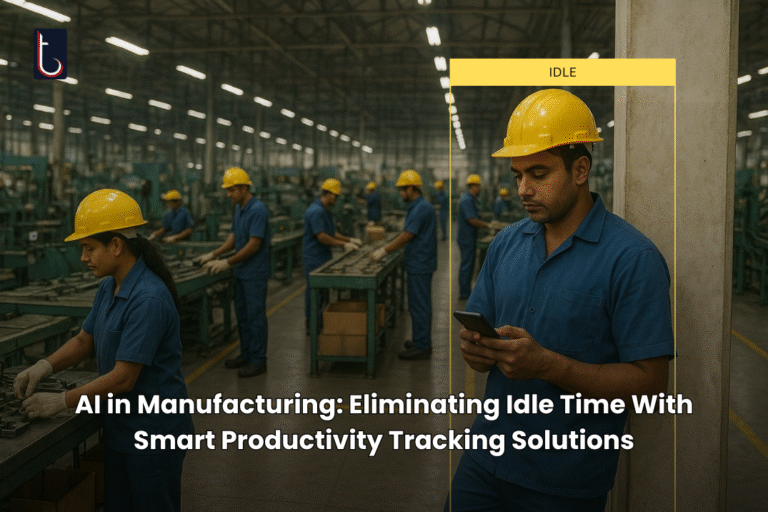
Idle time in manufacturing is rarely the result of workers intentionally standing still. It manifests in subtler forms: waiting for materials to arrive, walking to retrieve tools that should be at the workstation, pausing while a machine cycles, or losing time during uncoordinated shift transitions. These micro-interruptions are individually small but collectively substantial.
Traditional measurement methods struggle to capture this hidden idle time for several reasons. Manual observation is inherently intermittent and subject to observer bias. Self-reporting is unreliable and creates administrative overhead. Machine-level sensors can track equipment utilization but say nothing about what the operator is doing when the machine is idle. The gap between what leadership believes is happening and what is actually happening on the floor can be remarkably wide.
The AI Solution: Human Pose Recognition
Human pose estimation is a computer vision technique that identifies and tracks the positions of key body joints in real time. When applied to manufacturing environments, these models can distinguish between productive activities, such as assembling, inspecting, or operating machinery, and non-productive states, such as standing idle, walking away from a workstation, or engaging in off-task behavior.
The system works by processing video feeds frame by frame, detecting human figures, and mapping skeletal keypoints including shoulders, elbows, wrists, hips, knees, and ankles. By analyzing the temporal sequence of these poses, the AI can classify activities with high accuracy. A worker performing a repetitive assembly task produces a distinct pattern of movements that differs clearly from someone standing stationary or walking between stations.
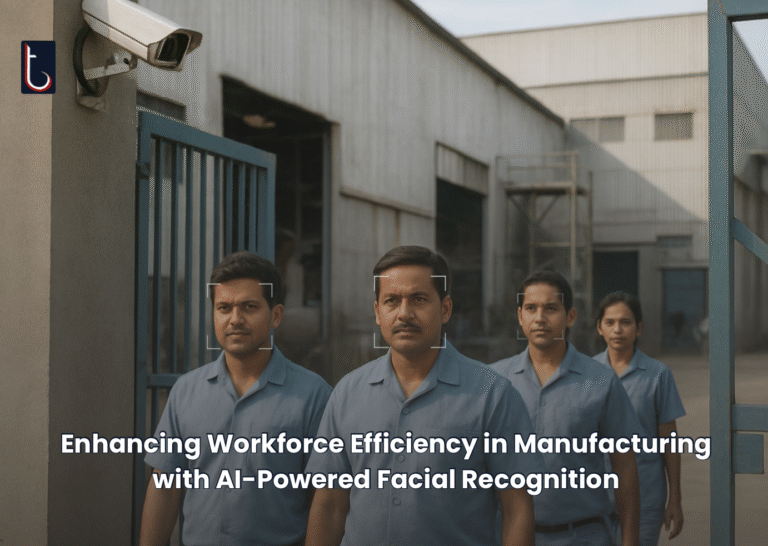
Crucially, these systems can be configured to operate without identifying individuals. They track body movements and activity states, not faces, which addresses many privacy concerns associated with workplace monitoring.
Real-Time Dashboard Capabilities
The raw output of pose estimation models feeds into dashboards that give plant managers an unprecedented level of operational visibility. Key capabilities include:
- Live activity heat maps: Visual representations of where productive work is concentrated and where idle zones exist, updated in real time across the entire facility.
- Station-level utilization rates: Granular metrics showing the percentage of time each workstation is actively in use versus idle, broken down by shift, time of day, and day of week.
- Idle time categorization: Automated classification of idle periods by probable cause, such as material wait, equipment downtime, or unassigned idle, enabling targeted corrective action.
- Trend analysis: Historical data that reveals whether productivity is improving or degrading over weeks and months, and which interventions have the greatest impact.
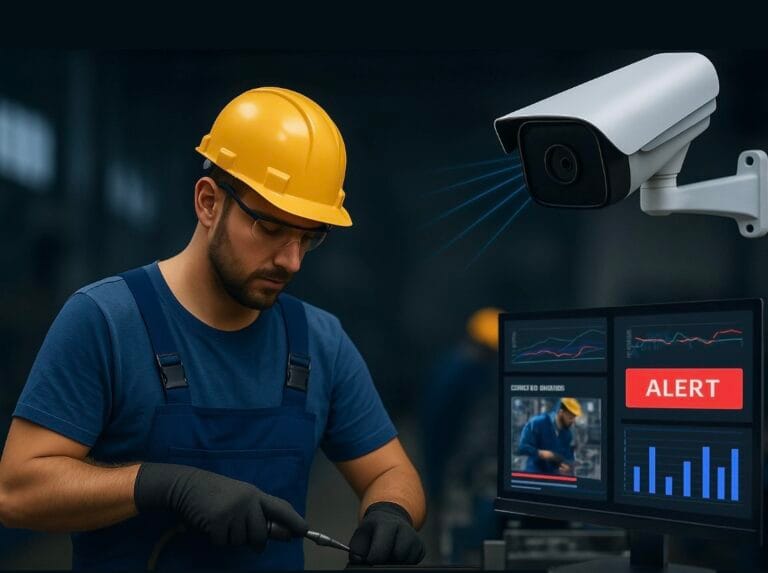
- Alert triggers: Configurable thresholds that notify supervisors when idle time at a station or zone exceeds acceptable limits, enabling immediate response rather than after-the-fact discovery.
Data-Driven Performance Metrics
The shift from manual observation to AI-powered tracking transforms how performance is measured and managed. Instead of relying on output counts alone, which tell you what was produced but not how efficiently, manufacturers gain access to process-level metrics that reveal the how.
Cycle time analysis becomes more precise because the system can measure the actual time a worker spends on each task, including micro-pauses that traditional methods miss. Line balancing benefits from data showing where bottlenecks form not because of machine capacity but because of human workflow patterns. Shift handover efficiency can be quantified by measuring the time between one shift leaving stations and the next shift reaching full productive activity.
These metrics create a feedback loop. When workers and supervisors can see objective data about workflow patterns, they can collaborate on process improvements that would never surface through periodic audits or anecdotal reporting.
Business Impact
The measurable business outcomes from smart productivity tracking typically emerge across several dimensions. Throughput increases as hidden idle time is identified and reduced. Labor cost per unit decreases as existing workers are deployed more effectively, reducing the need for additional headcount. Quality tends to improve because consistent, uninterrupted work patterns correlate with fewer errors and defects.
Beyond the direct financial impact, there are strategic benefits. Manufacturers gain the ability to simulate the productivity impact of layout changes, staffing adjustments, or process redesigns before implementing them. This data-driven approach to continuous improvement replaces guesswork with evidence, accelerating the pace at which operational gains are realized.
Why Now
Three converging factors make this the right moment for manufacturers to adopt AI-powered productivity tracking.
First, hardware costs have dropped dramatically. The cameras required are standard industrial models, and the compute needed to run pose estimation at scale is available through affordable edge devices or cloud processing. A facility does not need to invest in specialized sensing infrastructure.
Second, the algorithms have matured. Pose estimation models trained on large-scale datasets now achieve high accuracy in cluttered, variable-lighting environments typical of manufacturing floors. Five years ago, these models required controlled conditions to perform well. Today, they handle the messy reality of production environments reliably.
Third, scalability is straightforward. A system deployed on one production line can be extended to an entire facility, and then to multiple facilities, using the same software platform. Data aggregation across plants enables enterprise-level benchmarking and best-practice sharing that was previously impractical.
Additional AI Applications in Manufacturing
Smart productivity tracking is one entry point into a broader AI toolkit for manufacturing. Once the camera infrastructure and data pipeline are established, the same system can support additional capabilities including quality inspection through visual defect detection, safety monitoring through PPE compliance checks, and predictive maintenance through equipment vibration and thermal analysis. Each additional application leverages the same foundational investment, improving the overall return.
Conclusion
Hidden idle time is one of the largest untapped opportunities for efficiency gains in manufacturing. Traditional methods of identifying and addressing it are too slow, too intermittent, and too subjective to drive meaningful improvement. AI-powered productivity tracking, built on human pose recognition and real-time analytics, provides the continuous, objective measurement that manufacturers need to close the gap between planned and actual performance. The technology is ready, the economics are favorable, and the competitive pressure to adopt is growing.