Why Quality Control Needs More Than a Checklist
Plant managers operate under constant pressure to maintain quality while meeting production targets. Traditional quality control methods -- manual checklists, periodic sampling, and end-of-line inspection -- were designed for a slower, simpler manufacturing environment. Today's production lines generate enormous volumes of data from sensors, cameras, and process control systems, yet most of that data goes unused for quality purposes.
The gap between available data and actionable quality intelligence represents a significant opportunity. The five methods outlined here use data that most plants already collect -- or can begin collecting with modest investment -- to prevent defects rather than merely detect them after the fact.
Method 1: Predictive Analytics for Defect Prevention
Predictive analytics applies statistical and machine learning models to process data in order to forecast when and where defects are likely to occur. Rather than reacting to defects after they appear, predictive models identify the conditions that precede them.
The approach works by correlating historical defect data with process variables such as temperature, pressure, humidity, material batch characteristics, and machine operating parameters. When the model detects a combination of variables that historically leads to defects, it alerts operators before the defects materialize.
Implementation starts with identifying the highest-impact defect categories and collecting the process data associated with those defects. Even relatively simple models -- logistic regression or decision trees -- can deliver substantial value when trained on clean, well-structured data. As the data infrastructure matures, more sophisticated models can be layered in to capture subtler patterns.
Method 2: Real-Time Vision Systems
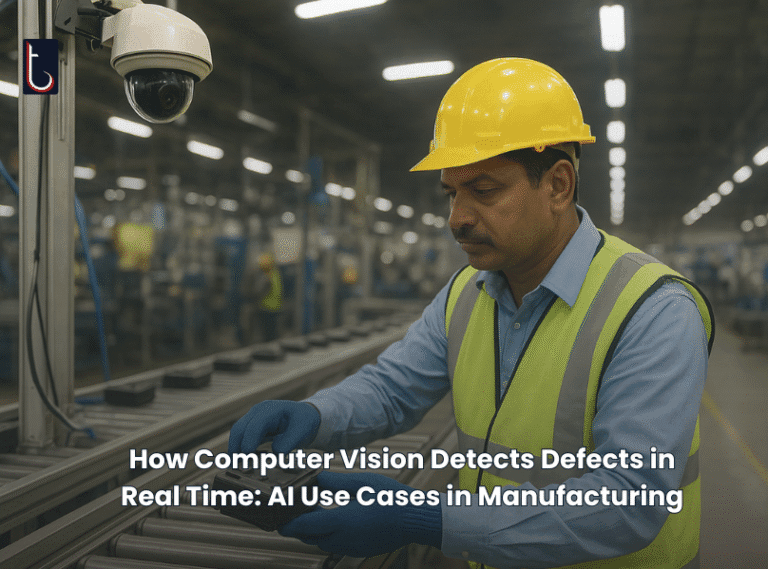
Camera-based inspection systems powered by deep learning algorithms -- a core capability within modern AI solutions for manufacturing -- provide continuous, objective quality assessment at production speed. These systems inspect every unit rather than relying on statistical sampling, catching defects that sampling-based approaches inevitably miss.
Modern vision systems go beyond simple pass-fail classification. They can grade defect severity, categorize defect types, and track defect locations on the product. This granularity transforms inspection data into a diagnostic tool: when the system detects an increase in a specific defect type at a specific location, it points directly to the root cause in the production process.
The practical advantage for plant managers is that vision systems operate independently of shift changes, operator experience levels, and the inevitable variability of human attention. They provide a consistent quality baseline that makes process improvements measurable and verifiable.
Method 3: Root Cause Analysis with Visual Intelligence
When defects occur, the speed and accuracy of root cause analysis determines how quickly the issue is resolved and how much material is scrapped. Traditional root cause analysis relies on manual investigation -- reviewing logs, interviewing operators, and examining samples -- which can take hours or days.
Visual intelligence accelerates this process by automatically correlating defect patterns with process events. When an inspection system detects a new defect pattern, the analytics platform can immediately cross-reference the timing, location, and characteristics of the defect with data from upstream processes. This automated correlation often identifies the root cause in minutes rather than days.
The data trail also supports more rigorous corrective action verification. After implementing a fix, the inspection system provides objective evidence of whether the defect rate has actually decreased, removing the ambiguity that often surrounds the effectiveness of corrective actions.
Method 4: AI-Powered Co-Pilot Assistant
AI co-pilot systems provide plant floor personnel with real-time guidance based on current production data. Unlike static work instructions, co-pilot systems adapt their recommendations to current conditions, helping operators make better decisions without requiring them to interpret complex data themselves.
In a quality context, a co-pilot might alert an operator that the current machine settings are drifting toward a parameter range associated with increased defect rates, and suggest specific adjustments. It might flag that a material batch has characteristics that require modified process parameters. Or it might guide a less experienced operator through a complex setup procedure that directly affects product quality.
The value proposition for plant managers is straightforward: co-pilot systems capture and distribute the knowledge of the most experienced operators, reducing the quality impact of workforce variability and accelerating the training of new personnel.
Method 5: Human-AI Collaboration Workflows
The most effective quality control systems combine AI capabilities with human judgment rather than attempting to replace one with the other. Human-AI collaboration workflows route decisions to the right decision-maker based on complexity and confidence level.
In practice, this means the AI system handles high-volume, well-defined inspection tasks autonomously while escalating ambiguous cases to human experts. The human decisions on escalated cases feed back into the AI model, continuously improving its capability over time. This creates a system that gets better with use while maintaining the safety net of human oversight for edge cases.
The workflow design matters as much as the technology. Effective collaboration requires clear escalation criteria, intuitive interfaces that present relevant context to human reviewers, and feedback mechanisms that close the loop between human decisions and model updates. When these elements are well-designed, the combined system outperforms either humans or AI operating alone.
Conclusion
Data-driven quality control is not about replacing proven quality disciplines -- it is about augmenting them with capabilities that manual processes cannot match. Each of the five methods described here addresses a specific limitation of traditional quality control: the inability to predict defects before they occur, the inconsistency of human inspection, the slowness of root cause analysis, the challenge of distributing expert knowledge, and the false choice between human and automated quality systems. Plant managers who adopt these methods systematically will find that quality improvement and productivity improvement are not competing objectives but complementary ones. Learn more about how data-driven quality control is transforming manufacturing operations.