AI Quality as a Strategic Capability
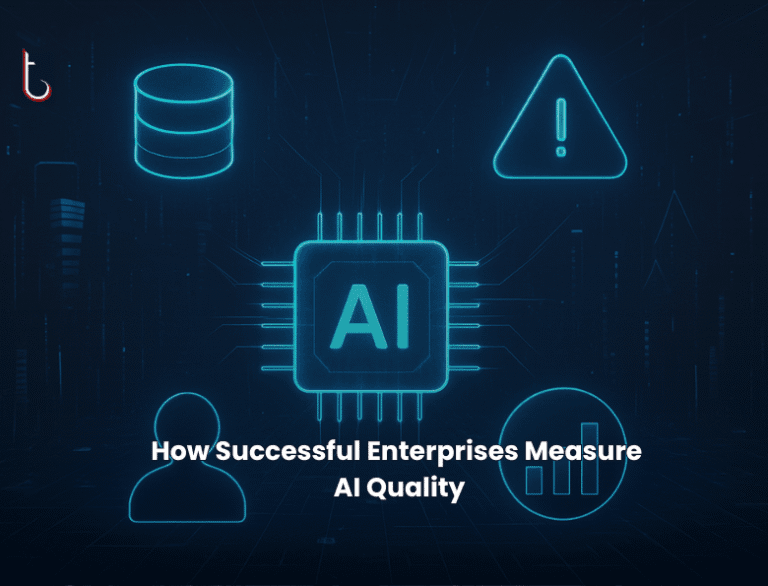
For enterprises deploying AI at scale, quality is no longer a technical detail to be handled by the data science team alone. It is a strategic capability that determines whether AI investments generate returns or become expensive liabilities. The difference between organizations that successfully scale AI and those that stall after pilot programs often comes down to how systematically they measure and manage quality across the entire AI lifecycle.
Yet most organizations lack a coherent framework for defining what quality means in the context of their AI systems. Without clear definitions and consistent measurement, teams cannot make informed decisions about when a model is ready for production, when it needs retraining, or when it should be retired.
Five Dimensions of AI Quality
Business Value Alignment
The most technically excellent model is worthless if it does not address a real business need. Business value alignment measures whether the AI system is solving the right problem and generating measurable impact. Key indicators include revenue influence, cost reduction, process efficiency gains, and customer experience improvements. These metrics should be defined before model development begins and tracked continuously after deployment.
Technical and Model Performance
This dimension covers the traditional metrics that data scientists are most familiar with: accuracy, precision, recall, F1 score, latency, throughput, and resource consumption. But it also extends to robustness testing, performance across demographic subgroups, behavior under distribution shift, and graceful degradation under adversarial inputs. Technical performance should be evaluated not just on average cases but across the full distribution of expected inputs.
Data Readiness
Model quality is bounded by data quality. Data readiness encompasses the completeness, accuracy, consistency, freshness, and representativeness of training and evaluation datasets. It also includes the maturity of data pipelines, the reliability of data collection processes, and the existence of data quality monitoring. Organizations that neglect data readiness invariably encounter model quality problems downstream.
Risk, Fairness, and Ethics
AI systems can create significant legal, reputational, and ethical risks if deployed without appropriate safeguards. This dimension evaluates bias across protected attributes, compliance with applicable regulations, transparency of decision-making, and the existence of human override mechanisms. It also considers the potential for misuse and the adequacy of access controls. Risk assessment should be proportionate to the stakes of the application -- a product recommendation engine warrants different scrutiny than a medical diagnosis system.
Adoption and Usage
An AI system that nobody uses delivers zero value regardless of its technical merit. Adoption metrics track whether end users actually engage with the system, whether they trust its outputs, and whether the system integrates smoothly into existing workflows. Low adoption often signals usability issues, trust deficits, or a misalignment between what the system provides and what users actually need.
A Structured Measurement Framework
Measuring AI quality effectively requires a systematic process that connects business objectives to specific, measurable criteria. The following six-step framework provides a repeatable approach.
Step 1: Define the Business Objective
Start with a clear articulation of what the AI system is supposed to achieve in business terms. Avoid vague goals like "improve customer experience." Instead, specify measurable outcomes: reduce average support resolution time by 30%, increase first-contact resolution rate to 85%, or decrease customer churn by 5 percentage points.
Step 2: Translate Objectives into Quality Criteria
Map each business objective to the specific quality dimensions that most directly affect it. A customer service chatbot might require high accuracy on intent classification, low latency for real-time interaction, appropriate escalation behavior for sensitive topics, and consistent performance across customer demographics.
Step 3: Establish Specific Metrics
For each quality criterion, define concrete metrics with clear measurement methodologies. Specify what data is needed, how it will be collected, how frequently it will be measured, and who is responsible for tracking it. Ambiguous metrics that different teams interpret differently are worse than no metrics at all.
Step 4: Define Acceptable Thresholds
Set minimum performance thresholds that must be met before deployment and maintained during production. These thresholds should be informed by business requirements, regulatory constraints, and user expectations. Establish separate thresholds for launch readiness and ongoing operation, since production requirements may differ from initial deployment criteria.
Step 5: Build Monitoring Infrastructure
Implement automated monitoring systems that continuously track key metrics against defined thresholds. Configure alerting for significant deviations. Build dashboards that provide visibility to both technical teams and business stakeholders. Monitoring infrastructure should be treated as a required component of any production AI system, not an optional enhancement.
Step 6: Establish Feedback Loops
Create mechanisms for monitoring outputs to inform model improvement. Production performance data should flow back to training pipelines. User feedback should be captured and analyzed systematically. Incident post-mortems should generate updated evaluation criteria. The measurement framework itself should evolve based on what it reveals about the system's actual behavior.
Measuring Generative AI Quality
Generative AI systems -- large language models, image generators, code assistants -- present unique measurement challenges because their outputs are open-ended and subjective.
Rubric-Based Human Evaluation
The most reliable approach for assessing generative output quality is structured human evaluation using detailed rubrics. Evaluators rate outputs across defined dimensions such as helpfulness, accuracy, safety, coherence, and task completion. Rubrics should include concrete examples for each rating level to ensure consistency across evaluators. Regular calibration sessions help maintain inter-rater reliability over time.
Synthetic Data Benchmarking
Synthetic evaluation datasets allow rapid, repeatable testing across a wide range of scenarios without relying on human evaluators for every iteration. These datasets can be designed to probe specific capabilities, test edge cases, and verify that model updates do not introduce regressions. The key is ensuring that synthetic benchmarks correlate well with real-world performance, which requires periodic validation against human judgments.
Fine-Tuning Evaluation
When models are fine-tuned for specific enterprise applications, evaluation must verify not only that target task performance improves but also that general capabilities are not degraded. Before-and-after comparison on a broad evaluation suite helps detect catastrophic forgetting or capability regression that might not be visible when testing only the fine-tuned task.
The Role of Human-in-the-Loop Quality Assurance
Automated metrics can scale to millions of evaluations per day, but they cannot fully replace human judgment on the dimensions that matter most: Is this response actually helpful? Does it sound trustworthy? Would it alarm or confuse a real user? Human-in-the-loop quality assurance combines the efficiency of automated systems with the judgment of trained evaluators.
Effective human-in-the-loop programs require investment in evaluator recruitment, training, and calibration. Domain expertise matters: evaluators assessing medical AI outputs need clinical knowledge; those evaluating legal AI need familiarity with legal reasoning. Quality assurance teams should operate with clearly defined sampling strategies, consistent rubrics, and regular recalibration to prevent drift.
Scaling AI Quality Across the Organization
A Central AI Quality Office
Organizations scaling AI across multiple business units benefit from a centralized quality function that sets standards, provides shared tooling, and ensures consistency. This team defines organization-wide quality frameworks, maintains evaluation infrastructure, and provides expertise to individual project teams. Centralization prevents the fragmentation that occurs when every team invents its own quality approach.
Data Infrastructure as a Foundation
Scalable AI quality depends on robust data infrastructure. This includes data catalogs that make evaluation datasets discoverable, versioning systems that track dataset evolution, pipeline orchestration that ensures data freshness, and access controls that balance usability with governance. Without this foundation, quality measurement becomes a manual, project-by-project effort that cannot scale.
Cross-Functional Collaboration
AI quality is not solely a technical concern. It requires collaboration between data scientists, domain experts, product managers, legal and compliance teams, and end users. Quality criteria should be defined jointly, not imposed by any single function. Regular quality reviews that bring together diverse perspectives help catch blind spots that any single team would miss.
Conclusion
Measuring AI quality is not a one-time activity or a simple checklist. It is an ongoing organizational practice that requires clear frameworks, appropriate tooling, skilled people, and executive commitment. The enterprises that invest in building this capability systematically will be the ones that successfully scale AI from pilot programs to enterprise-wide impact, while managing the risks that come with deploying increasingly powerful systems in consequential settings.