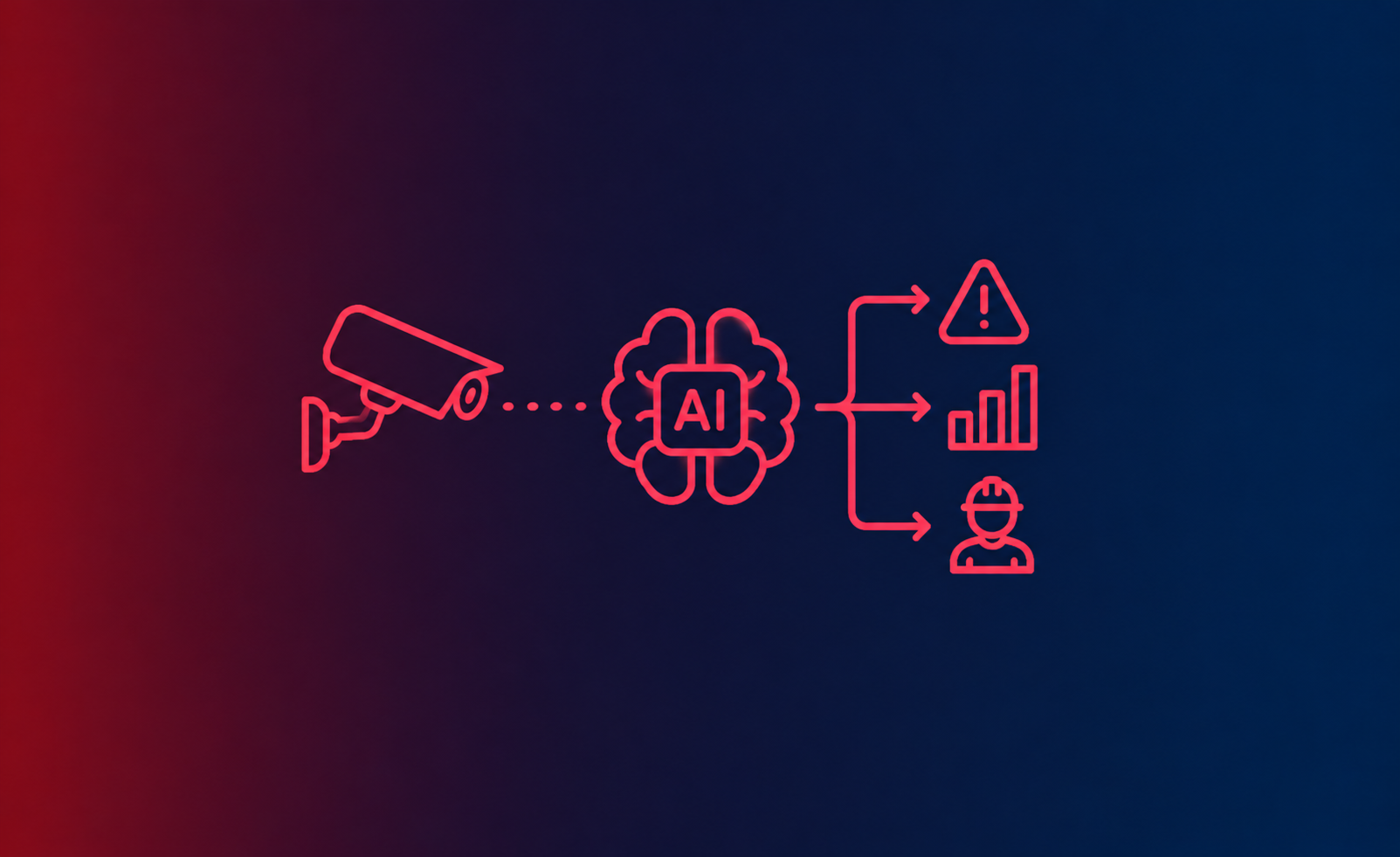
CCTV AI for manufacturing turns the cameras a plant already owns into a measurement system. Instead of recording footage that someone might review after an incident, AI reads every stream, counts what happens at each workstation and raises an alert when something drifts. Plant owners and operations heads across India now say they want "AI in the network," and then struggle to say what that means. What does the AI look at? Does it need new cameras? Can it really calculate OEE, catch a skipped SOP step or flag a missing helmet, and where does it get things wrong?
This guide answers those questions in plain terms. It follows video from the camera to the dashboard, shows what each stage of the AI does and which research supports it, and walks through six things AI can measure on a factory floor, with examples from automobile, garment and defence plants. It is honest about the limits, explains how CAM, our CCTV AI platform, is built, and ends with a practical way to start.
What Is CCTV AI for Manufacturing?
CCTV AI for manufacturing is software that analyses video from a plant's existing cameras and converts it into structured operational data: how long a workstation sat idle, whether a machine was running or stopped, whether a worker wore a helmet in a marked zone, whether an operator skipped a step. The cameras stay in place. The software is the new part.
Think of recording-only CCTV as eyes without a brain. It captures everything and understands nothing, so in many plants footage is opened mainly after something has gone wrong. AI adds the brain. It watches every stream continuously and reports what matters as a count, a timing or an alert.
| Traditional CCTV | CCTV AI for manufacturing | |
|---|---|---|
| Main job | Record video for later review | Turn video into live metrics and alerts |
| Who watches | A person, usually after an event | Software, continuously, on every shift |
| Output | Footage | Dashboards, alerts, logs and structured data |
This is why the phrase "AI camera" can mislead. For most uses you do not need a special camera. You need a way to read the video stream the camera already produces, and a model trained to recognise what happens in your plant.
Why Indian Plants Are Looking for AI in Their CCTV Network
Three problems come up again and again on Indian shop floors. Manual supervision limits real-time visibility, because a supervisor can only be in one place. Missed SOP steps and incomplete operations create quality gaps that surface late. And undetected PPE violations leave workers exposed to hazards that were preventable.
The usual answers are audits and supervisor walks, and both are samples. Duflo, Greenstone, Pande and Ryan studied environmental audits in Gujarat, where plants paid their own auditors, and found that an audit report was 29 percentage points more likely to show a plant as compliant than an independent backcheck. The point is not that auditors are careless. A sample, however honest, shows one slice of the floor, and a second independent record improves it.
Information is a bottleneck in its own right. In a randomised trial across Indian textile plants, Bloom, Eifert, Mahajan, McKenzie and Roberts found that better management practices raised average productivity by 11 percent, and concluded that informational barriers were a primary reason plants had not adopted them earlier. Cameras are the one source of floor information that most plants have already paid for.
How AI Reads Factory Video: The Five-Stage Pipeline
Behind every dashboard number sits the same chain. Knowing it helps you ask better questions of any vendor.
| Stage | What the AI does | Research behind it |
|---|---|---|
| 1. Capture | Pulls the video stream from the camera or recorder and prepares frames | Edge video analytics survey (Xu, Razavi and Zheng) |
| 2. Detect | Finds people, helmets, vests, tools and parts in each frame | YOLO (Redmon et al.) |
| 3. Track | Keeps the same identity on a person or object from frame to frame | ByteTrack (Zhang et al.) |
| 4. Understand | Reads body pose and classifies what the person is doing | OpenPose (Cao et al.), action recognition review (Pham et al.) |
| 5. Decide | Applies your rules and turns events into metrics and alerts | Plant-specific logic, not a model |
Stage 1: Capture. Cameras already send a continuous stream to a recorder, and the AI taps that stream. Xu, Razavi and Zheng's survey of edge video analytics explains the main design choice: the heavy processing can sit near the camera, on the plant network, or in a distant data centre. They give data volume, response time and information security as the reasons processing is moving to the edge.
Stage 2: Detect. Detection answers "what is in this frame?" The YOLO paper by Redmon and colleagues made this fast by treating detection as a single pass of one neural network over the whole image. The authors reported 45 frames per second for the base model and 155 for a smaller one, which is why detection can keep up with live video. Later versions of the YOLO family are widely used, and the PPE benchmark described below tests YOLOv9.
Stage 3: Track. Detection alone has no memory. Frame one shows a person, frame two shows a person, but is it the same person? Tracking links detections across frames so the system can measure how long someone stayed at a station. ByteTrack, by Zhang and colleagues, matters on a real floor because it keeps low-confidence detections, such as a person partly hidden behind a machine, instead of discarding them. It reports about 30 frames per second on a single GPU.
Stage 4: Understand. Now the system reads what people are doing. OpenPose, by Cao and colleagues, estimates body, hand, foot and face keypoints for several people at once in real time, and the authors report that this holds regardless of how many people are in the frame. A review by Pham and colleagues covers the deep learning models that classify human actions from video. In manufacturing, researchers have built datasets for exactly this problem: the HA4M dataset by Cicirelli and colleagues records 41 people performing a 12-action gear assembly across 217 videos, so models can learn to recognise assembly steps.
Stage 5: Decide. This stage is not a neural network. It is the logic that makes the output useful: "worker in Zone B without a helmet," "step three missing from the cycle," "station idle past the threshold." A good platform lets you set these rules per zone and per line, which is where your own process knowledge matters most.
What CCTV AI Can Measure on the Factory Floor: Six Capabilities
Once the chain works, the same camera network can answer several different kinds of question. These are the six that CAM covers, and what each one actually measures.
Worker productivity and idle time monitoring
Pose and action models separate productive from unproductive time at a workstation. CAM tracks a worker's availability at the workstation, break and idle durations, the live count of units processed, the real-time productivity rate against the expected rate, and cycle time compliance. When productivity dips below target, an alert goes out so the shift can recover. The value is objective data in place of estimates, and it usually points to a process problem, such as late material, before it points to a person.
Machine monitoring, OEE and root-cause analysis
OEE, overall equipment effectiveness, multiplies three ratios: availability, performance and quality. Most plants calculate it by hand from shift reports, if at all. CAM reads the existing CCTV, classifies every machine as running, idle or stopped, and calculates OEE per machine automatically. It also reports utilisation (productive time against available time, on every shift), actual cycle time against target job by job, a loss breakdown that ranks where non-production time goes, stoppage reasons categorised and logged with no manual entry, and on-time output against plan.
A camera infers machine state from what is visible. It does not measure vibration, temperature or current, which is the job of sensors, so the two are complementary and not rivals.
SOP adherence and quality process monitoring
Operators work through a sequence of steps, and some get skipped under pressure. CAM tracks whether workers follow every SOP step by monitoring cycle time, counts the units checked, and shows the quality distribution of approved, rejected and skipped units. Alerts fire for high rejection rates and skipped steps, so the deviation is caught at the station, not found weeks later in a customer complaint. The research basis is the same action-recognition work behind HA4M.
PPE and safety compliance monitoring
Detection models check for helmets, gloves, safety glasses and vests in critical zones, and rules decide which items each zone requires. Non-compliance triggers an instant alert, and historical compliance is stored with screenshots from the live feed, so safety reports and audits have evidence behind them. PPE detection is an active research area for manufacturing. The SH17 dataset by Ahmad and Rahimi offers 8,099 annotated images with 75,994 labelled instances across 17 classes, drawn from public photographs of industrial workers.
Automated visual quality control
AI can inspect products for colour mismatches and inconsistencies, cracks, dents and other surface flaws, and misalignments or missing parts in assembly. CAM sends instant alerts with visual logs for rejections, and improves through custom-trained models fed by continuous data-training pipelines. The training point matters because defects are rare. A survey by Jin and Chen notes that defect data is hard to collect and expensive to annotate, which is why methods that learn from few labelled examples, and pipelines that keep training on new ones, carry so much weight. Inspection-grade views usually need a camera positioned and lit for the task.
Attendance, access control and shift management
Faces and ID scans can replace manual punching. CAM can log attendance through facial recognition or an ID scan, track entry and exit movements, manage access to restricted zones and the wider facility, and pass records to payroll software. Because this touches identifiable people more directly than any other capability, it needs the most care on privacy, which we cover below.
How Indian Manufacturers Use CCTV AI: Automobile, Garments and Defence
The capabilities look different on different floors.
| Industry | Use | What gets measured |
|---|---|---|
| Automobile | Workstation monitoring | SOP compliance on critical workstations so no step is missed, early detection of process deviations, and worker-level efficiency to cut idle time |
| Garments | Operator productivity monitoring | Cycle time and number of operations for every operator on a line, whether operators are working, and insight into the best operators for smarter line planning |
| Defence | CNC productivity monitoring | CNC machining cycle times, timely part changes, extended task durations, productivity losses and worker efficiency |
Notice the shared pattern. In each case one camera over one critical workstation or machine produces a time-stamped record of what happened, and the plant decides what to do with it. The same infrastructure serves all three because the measurement layer, not the industry, is what is common.
Camera AI, IoT Sensors and Manual Audits: Why They Work Together
Camera AI does not replace the other two methods. Each sees a different part of the floor.
| Method | Strongest at | Blind spot |
|---|---|---|
| IoT and PLC sensors | Precise machine signals such as vibration, temperature, current and counts | People and process: why a machine stopped, whether a step was skipped |
| Manual audits | Judgment calls, such as whether a finish will pass the customer | Everything outside the sample, including other shifts |
| CCTV AI | People, process and visible machine state, on every shift | Anything outside the frame, and internal machine condition |
Sensors have their own difficulty in older plants. A systematic review of 32 papers on retrofitting legacy machines, by Alqoud, Schaefer and Milisavljevic-Syed, found that 62.5 percent added IoT hardware and gateways, and listed obstacles such as mixed protocols, skills gaps and unclear return on investment. Cameras are often already in place. Many plants end up using all three, with each one checking the others: a sensor reports the stoppage, the camera shows why it happened, and an audit confirms the fix is sound.
What CCTV AI Cannot Do
An honest guide has to cover the failures, because they decide whether a deployment works.
It only sees what the camera sees. Machines, people and stacked material block the view, and a camera hung to watch a gate may not see a workstation. This is why a coverage check of each critical workstation comes first.
Models do not transfer automatically from one site to another. The SH17 authors give a useful warning. Their best model, YOLOv9-e, scored 70.9 percent mAP@50 on their own held-out test split. On a different public dataset, Pictor-PPE, helmet recall was only 23.7 percent, and helmets were often confused with heads. A model trained on other factories' images will not necessarily work on yours, so validation on your own footage must come before anyone acts on an alert.
Small and hidden objects are hard. In the same paper, 52 percent of objects covered less than 1 percent of the image area, and classes with a varied appearance, such as tools and feet, scored low. Camera placement and resolution matter as much as the model.
Accuracy needs maintenance. Lighting changes, layouts move and uniforms get replaced. A system that is not re-checked drifts.
Ask any vendor, including us, to show validation on your own footage and to explain how accuracy is reviewed after go-live.
How CAM Works: Architecture, Integration and Deployment
CAM stands for CCTV AI for Manufacturing. It upgrades existing CCTV systems into workstation monitoring platforms that deliver real-time insight on workforce and production performance. Each workstation can be tracked with a single camera, so productivity, safety and quality are covered across every shift.
| CAM layer | What it does |
|---|---|
| Capture | Overhead CCTV cameras monitor critical workstations continuously, with streams taken over RTSP or from the NVR |
| Analyze | GPU-optimised models process the video through DeepStream pipelines, at the edge or in the cloud depending on the module |
| Insight | Structured data flows to dashboards with real-time alerts and analytics |
| Integrate | Existing ERP and MES systems connect through secure APIs |
DeepStream is NVIDIA's open-source toolkit, built on GStreamer, for real-time video pipelines with GPU-accelerated inference. In practice it is what lets many camera streams run through detection and tracking models at once.
Three ways to deploy. Edge deployments run inference on site on NVIDIA Jetson AGX Orin or RTX hardware, need no internet and keep video on the plant network. Cloud deployments process streams on cloud infrastructure and suit stable networks and multi-site rollouts. Hybrid deployments keep real-time alerts at the edge and run central analytics and reporting in the cloud. The choice depends on your network, privacy and latency needs.
Modules by use case. CAM is deployed module by module, so a plant starts with the capability that addresses its biggest problem and adds others on the same cameras.
A process-first start. Our implementation begins with a process diagnostic, so the first measurements answer a question you already have. Quarterly reviews then cover model performance, accuracy recalibration and return on investment, which addresses the drift problem described above.
The True Potential of CCTV AI: From Monitoring to a Measurement Layer
The full value of CAM is not any single detection. It is what happens when one camera network feeds several operational questions at once.
One network, many questions. The same overhead camera that counts units at a workstation also sees whether the operator wore the right PPE, followed the SOP and kept pace with the cycle time. Because the cameras, edge devices and networking are shared across modules, each new use case builds on what is already installed.
Objective data replaces estimates. Idle time, utilisation and loss breakdowns become measured numbers, not end-of-shift guesses, so conversations between supervisors, managers and owners start from the same record.
Problems surface in real time. A skipped step, a missing helmet or a machine stopped for an unrecorded reason is flagged when it happens, not found at the next audit.
The data feeds planning. Through secure APIs, CAM connects to existing ERP and MES systems, so floor measurements can inform line planning, such as identifying the best operators for a line, and plan-versus-actual output.
The models improve. Custom-trained models and continuous data-training pipelines mean accuracy can improve on your own footage over time, instead of staying at whatever a generic model delivered on day one.
None of this removes the need for supervisors, sensors or audits. It gives each of them a continuous, shared record to work from.
Worker Privacy, Facial Recognition and the DPDP Act
Cameras point at people, so privacy is part of the design. India's Digital Personal Data Protection Act, 2023 governs how personal data is processed, and its rules were notified on 14 November 2025, with most obligations taking effect eighteen months later, around May 2027. Video in which workers can be identified, and face data used for attendance, is personal data. The Act allows processing without consent for certain legitimate uses, including purposes of employment or safeguarding the employer from loss or liability (Section 7(i)). How far that covers continuous AI monitoring and facial recognition is a question for counsel, not a blog post.
Facial recognition deserves a separate caution. NIST's 2019 study of 189 face recognition algorithms found that error rates differ across algorithms and demographic groups, with false positives varying by factors of 10 to more than 100 in some comparisons. NIST used US government image sets, not factory video, and recommended reporting error rates at the threshold a system actually uses. So ask any vendor for error rates on your own workforce, at your own gates, in your own light. An ID scan is a fallback where face matching is a poor fit.
The research adds a second point. Bernstein studied a Chinese mobile phone factory and found that full observability can lower performance, because workers conceal workarounds, while modest privacy at group level improved line performance. Watching more is not the same as learning more. Four design choices help: measure process steps, counts and timings, not named individuals, where you can; process video on site, which edge deployment allows; set a retention period and keep to it; and tell workers what is measured and why before the first day.
How to Start With CCTV AI in Your Plant
You do not need a plant-wide programme to find out whether this works. Start small and make the test fair.
- Pick one workstation or machine with a problem you can name. Idle time, a skipped step, repeated stoppages or a PPE rule in one zone will do.
- Begin with a process diagnostic. Map how the work should flow, so the first measurements answer a real question.
- Check camera coverage. Look at the live feed from above the workstation. Check angle, resolution and light, and note blind spots.
- Write the question as a measurement. "Percentage of cycles with step three skipped" can be checked. "Improve compliance" cannot.
- Validate before you act. Compare the AI's output with a manual audit of the same shifts, and agree an accuracy threshold in advance.
- Expand deliberately. Add the next module on the same cameras, then connect the data to your ERP or MES.
Frequently Asked Questions
What is CCTV AI for manufacturing?
CCTV AI for manufacturing is software that analyses the video from a plant's existing cameras and converts it into data on productivity, machine performance, safety, quality and attendance. It detects people, objects and actions, tracks them over time, and applies plant-specific rules to produce counts, timings and alerts. The cameras themselves usually stay unchanged.
How does AI work in CCTV cameras?
AI reads the video stream in stages. A detection model finds people and objects in each frame, a tracker follows them from frame to frame, pose and action models interpret what they are doing, and a rules engine turns those events into metrics and alerts. Most of the processing runs on an edge device or server connected to the cameras, not inside the camera.
Can AI be added to existing CCTV cameras?
Often yes. Cameras with a clear view of the workstation, enough resolution and adequate light can usually feed an AI system through the recorder or the camera stream. Cameras placed to watch gates and corridors may not see the work, so a coverage check comes first, and some plants reposition a few cameras over critical workstations.
Can CCTV AI calculate OEE and track machine downtime?
Yes, from visible machine state. CAM classifies each machine as running, idle or stopped from the existing CCTV, then calculates OEE, utilisation and cycle time per machine and ranks where lost time goes. Cameras infer state from what they can see, so sensors remain the better source for vibration, temperature and current.
What can AI detect on a factory floor?
AI can detect worker availability and idle time, PPE use, whether SOP steps happen in sequence, machine running and stopped states, visual defects such as cracks, dents and missing parts, attendance and entry to restricted zones. Inspection-grade defect detection usually needs a camera positioned and lit for that purpose.
Does CCTV AI need internet?
Not always. Edge deployments run inference on site and need no internet, which keeps video on the plant network. Cloud and hybrid deployments need a stable connection. The right model depends on your network, privacy and response-time needs.
How is worker privacy handled with AI CCTV and facial recognition in India?
Through design choices made before rollout: measure process steps and counts rather than named individuals where possible, process video on site, set and enforce a retention period, limit who sees footage, and tell workers what is recorded. Video of identifiable workers and face data are personal data under India's DPDP Act, 2023, with most obligations phasing in around May 2027, so involve legal counsel.
What is CAM by Biz-Tech Analytics?
CAM stands for CCTV AI for Manufacturing. It is Biz-Tech Analytics' platform that upgrades existing CCTV into workstation monitoring, covering worker productivity, machine monitoring and OEE, SOP and quality tracking, PPE compliance, automated quality control, and attendance and access control. It connects to existing ERP and MES systems and deploys at the edge, in the cloud or as a hybrid.
See Your Floor the Way Your Cameras Already Do
Your cameras already watch every shift. CCTV AI for manufacturing is the layer that turns that footage into something a plant manager can act on: a measurement, a trend, a timely alert. It will not replace sensors or audits, and it needs validation on your own footage, but it adds the one view of people, process and machines that most plants have never measured.
We built CAM to do this on the camera network you already own, starting from one workstation and growing module by module. If you want to see what a single camera over a single workstation can tell you, we would be glad to talk through your floor.