The Transformation of Workforce Management
Manufacturing floors have long relied on manual processes for managing workforce attendance, monitoring safety compliance, and tracking productivity. Badge-based systems, paper logs, and periodic supervisor walkthroughs remain the norm in many facilities. These approaches are slow, error-prone, and fundamentally reactive. By the time a compliance gap or attendance discrepancy is flagged, the operational damage has already occurred.
AI-powered facial recognition is changing this equation. By leveraging existing CCTV infrastructure and modern deep learning algorithms, manufacturers can automate identity verification, enforce safety protocols, and generate real-time workforce analytics without adding friction to daily operations. The result is a shift from periodic manual audits to continuous, automated oversight.
How Facial Recognition Works in Manufacturing
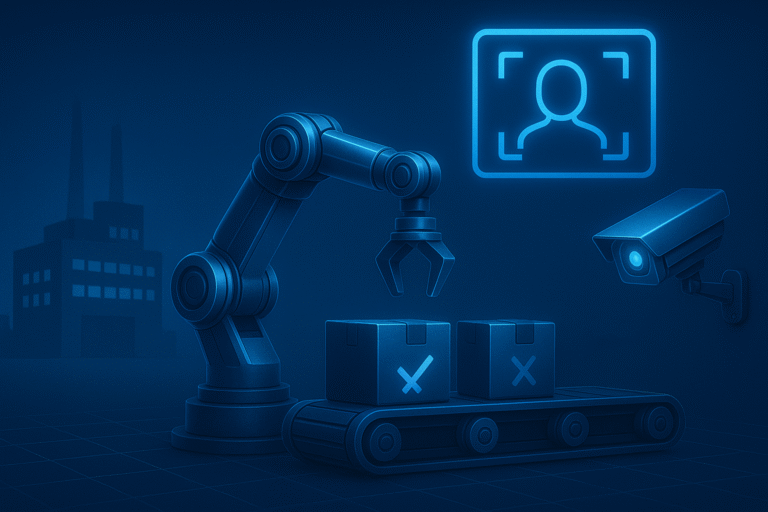
A manufacturing-grade facial recognition system operates through four distinct stages, each building on the last to deliver reliable identification in real-world industrial conditions.
Stage 1: Face Capture
Cameras positioned at entry points, workstations, and production lines capture video feeds continuously. Modern systems work effectively across a range of lighting conditions, angles, and distances that are typical of factory environments. Edge computing devices can preprocess frames locally before transmitting relevant data, reducing bandwidth requirements and latency.
Stage 2: Feature Extraction
Deep neural networks analyze each detected face and generate a compact mathematical representation known as a face embedding. This encoding captures the unique geometric and textural features of an individual's face, including the spatial relationships between key landmarks such as eyes, nose, and jawline. These embeddings are robust to minor changes in appearance, such as facial hair or eyewear.
Stage 3: Matching and Identification
The extracted embedding is compared against a database of enrolled employees. Similarity scoring algorithms determine whether the detected face corresponds to a known individual. Configurable confidence thresholds allow plant managers to balance between security requirements and throughput speed, ensuring the system adapts to the operational context of each facility.
Stage 4: System Integration
Once identification is confirmed, the system triggers downstream actions. These can include logging attendance in an HR platform, granting access to restricted zones, flagging an unrecognized individual for security review, or updating a real-time dashboard that tracks workforce distribution across the plant.
Key Use Cases
Automated Attendance Tracking
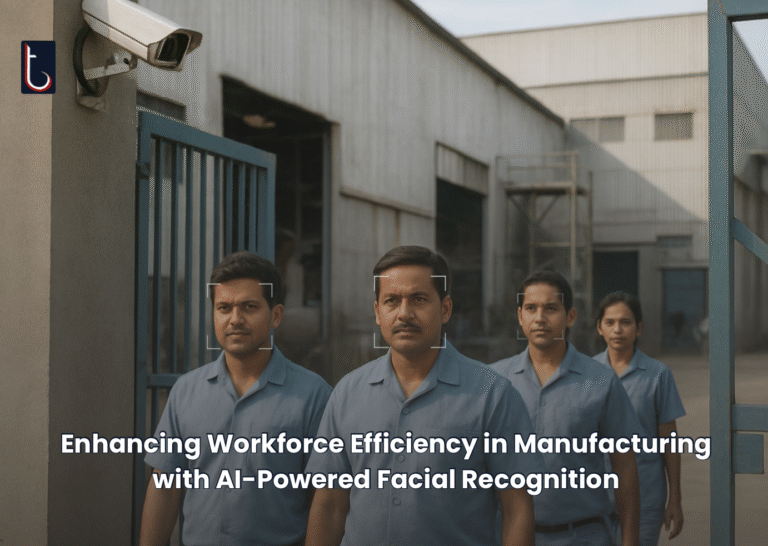
Traditional badge or biometric systems require employees to stop and interact with a terminal, creating bottlenecks during shift changes. Facial recognition enables contactless, walk-through attendance logging. Employees are identified as they enter the facility, and their arrival and departure times are recorded automatically. This eliminates buddy punching, reduces queuing at entry gates, and provides accurate records for payroll and compliance reporting.
Real-Time Workforce Monitoring
Plant supervisors often lack visibility into where workers are deployed at any given moment. Facial recognition integrated with floor cameras provides a live map of workforce distribution, showing which workers are at their assigned stations and which areas are understaffed. This enables faster response to production imbalances and more effective shift planning over time.
PPE Compliance Verification
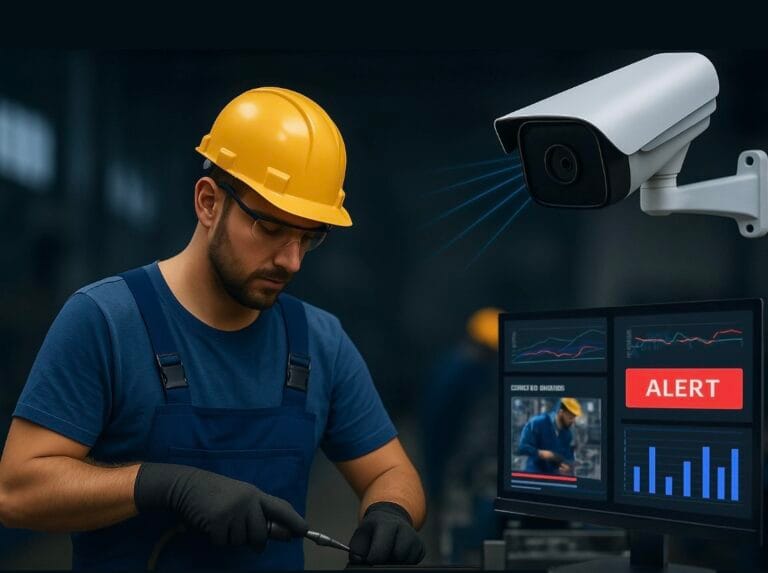
Personal protective equipment compliance is a persistent challenge on manufacturing floors. AI systems can be trained to detect not only faces but also the presence or absence of required safety gear such as helmets, goggles, and masks. When a worker is identified entering a zone without the required PPE, the system can trigger an immediate alert to the safety team, log the violation, and even activate physical barriers in high-risk areas.
Restricted Area Access Control
Certain zones within a manufacturing facility, such as chemical storage areas, high-voltage rooms, or clean rooms, require access to be limited to authorized personnel. Facial recognition replaces or supplements keycard systems by verifying identity in real time. Unauthorized individuals trigger instant alerts, and all access attempts are logged for audit purposes, creating a comprehensive security trail.
Productivity Analytics
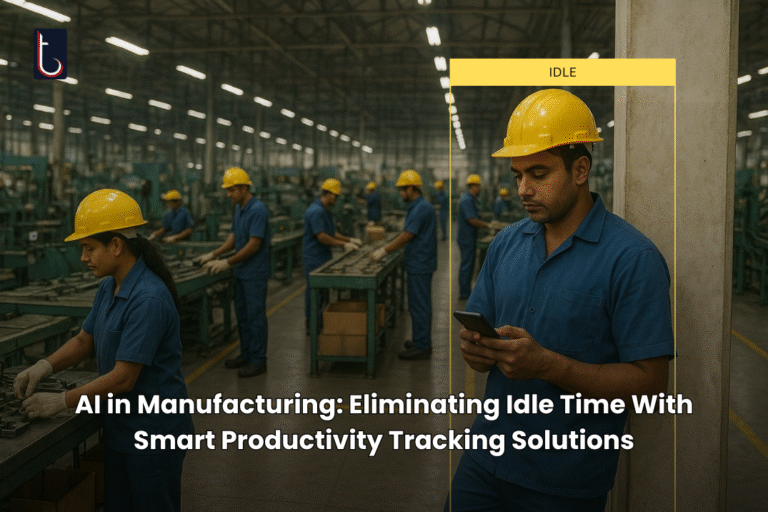
By correlating identity data with location and time-on-station metrics, facial recognition systems can generate granular productivity reports. Plant managers can analyze patterns such as average time spent at workstations, frequency of breaks, and movement between production areas. These insights, aggregated and anonymized where appropriate, support data-driven decisions around staffing levels, process optimization, and incentive programs.
Privacy and Security Considerations
Deploying facial recognition in a manufacturing environment carries significant privacy obligations that must be addressed from the outset. The most effective implementations follow several core principles.
First, data minimization ensures that only the biometric data necessary for the defined use case is collected and stored. Face embeddings, rather than raw images, should be retained wherever possible. Second, informed consent requires that all employees are clearly notified about what data is collected, how it is used, how long it is retained, and what rights they have regarding their biometric information.
Third, access controls must restrict who within the organization can view, export, or modify biometric records. Role-based permissions and audit logging are essential. Fourth, regulatory compliance demands alignment with applicable data protection frameworks, which vary by jurisdiction. In many regions, biometric data is classified as sensitive personal information and subject to heightened protections.
Manufacturers that address these considerations transparently tend to see higher adoption rates among their workforce and fewer legal complications during deployment.
Smart Factory Integration
Facial recognition delivers the most value when it is integrated into the broader smart factory ecosystem rather than operating as a standalone system. When connected to Manufacturing Execution Systems, it can automatically assign tasks to workers as they arrive at a station. When linked to ERP platforms, it can feed accurate labor hours directly into cost accounting modules.
Integration with IoT sensor networks enables contextual awareness. For example, if environmental sensors detect elevated temperatures in a zone, the system can cross-reference which workers are present and ensure they have the appropriate heat-stress training certifications. This kind of multi-system coordination turns facial recognition from a simple identification tool into a component of a comprehensive operational intelligence layer.
Conclusion
AI-powered facial recognition in manufacturing is not a futuristic concept waiting for the right conditions. The hardware is already installed in most facilities in the form of existing CCTV systems, and the algorithms have matured to the point where they deliver reliable performance in industrial settings. The organizations that move early on this technology gain measurable advantages in workforce efficiency, safety compliance, and operational visibility. Those that delay will find themselves managing increasingly complex operations with tools that were designed for a simpler era.