Introduction
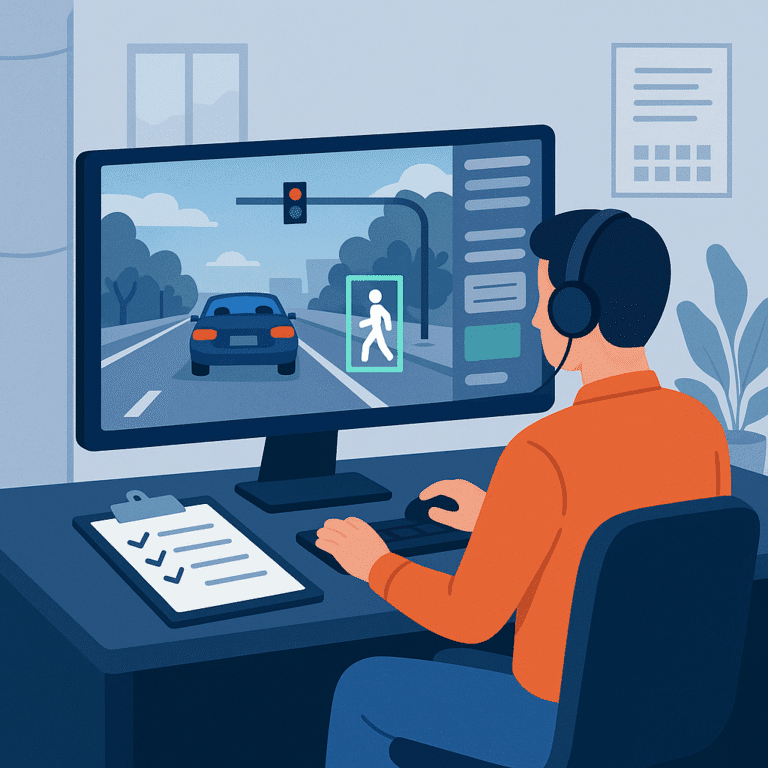
A behavioral training dataset was developed for a leading self-driving AI company by classifying 100,000 short driving clips based on specific vehicle actions. The project was completed in 4 weeks with 95% accuracy. Each 4-second clip was reviewed by licensed annotators who identified and categorized the driving behaviors captured in the footage.
The Challenge
Building training data for autonomous driving systems requires annotators to interpret fast-moving, context-dependent visual scenarios with precision.
- Global data diversity: Video clips originated from the US, UK, and Germany, each governed by different traffic rules, road markings, and driving conventions.
- Hierarchical labeling complexity: The classification system contained 30 to 40 levels of depth, requiring annotators to navigate a detailed taxonomy for every clip.
- Real-time decision modeling: Events unfolded within 4-second windows, demanding rapid yet accurate interpretation of vehicle behavior.
- Edge case sensitivity: Rare and ambiguous traffic scenarios -- near-misses, unusual pedestrian behavior, obscured signage -- required careful judgment that could not be automated.
The Solution
Our team established a structured annotation pipeline designed for both speed and accuracy at the scale required.
- Focused clip review: Each 4-second clip received a dedicated review with hierarchical classification applied according to the client's multi-level taxonomy.
- Behavioral context labeling: Annotators tagged clips with client-defined behavioral categories that captured not just what happened, but the intent and context behind each driving action.
- Agent identification: All traffic participants -- vehicles, pedestrians, cyclists -- were identified and their interactions with the subject vehicle documented.
- Structured annotation protocol: A standardized workflow ensured consistency across annotators and regions, with built-in calibration checkpoints.
The Result
The project delivered a comprehensive behavioral dataset that met the client's requirements for training and validating autonomous driving models.
- 100,000 annotated clips delivered on time within the 4-week engagement
- 95% accuracy rate across the full dataset
- Region-specific driving nuances captured for US, UK, and German traffic environments
- Fine-grained behavioral data ready for reinforcement learning and safety model training